In the early phase of Shoutly AI’s evolution, its engineers treated data like a living biography. Consequently, they observed how teams behaved across social platforms before writing a single line of automation logic. Furthermore, the central concept appeared not as a working hypothesis inside their dashboards. Thus, customers began to see social media as a system that could be measured, verified, and improved with precision.
The Rise of Intelligent Social Media Engineering
Moreover, Shoutly AI’s customers did not begin with automation. They began with observation. Therefore, the platform recorded posting rhythms, engagement patterns, and audience cycles at server level. Specifically, engineers layered NPI registry-style validation into account verification, ensuring each social identity mapped to a consistent digital signature.
Consequently, teams gained trust in the data before they trusted automation. Thus, when scheduling engines activated, they acted on verified behavioral signals rather than assumptions. Furthermore, this trust created a foundation for consistent execution across campaigns.
The Engineering Mindset Behind Automation
Furthermore, Shoutly AI approached automation as a sequence of decisions, not a single command. Therefore, each feature reflected a step in human reasoning. Specifically, the system asked what to post, when to post, and why it mattered.
Thus, customers experienced a shift. They moved from reactive posting to deliberate orchestration. Moreover, this orchestration mirrored how engineers think – structured, repeatable, and measurable.
Customer Journeys Through Data Precision
Moreover, one e-commerce team began by analyzing failed campaigns. Consequently, Shoutly AI mapped inconsistencies in timing and audience overlap. Therefore, the system suggested structured posting intervals based on verified engagement windows.
Furthermore, a media agency studied cross-platform identity validation. Thus, NPI-style registries ensured each client account passed server-level authentication before campaigns launched. Specifically, this reduced account-level risks and improved campaign reliability.
Moreover, a startup founder approached the system differently. Consequently, they focused on audience segmentation and message timing. Therefore, Shoutly AI recommended content variations aligned with micro-engagement clusters.
Thus, these journeys revealed a consistent pattern. Automation worked best when it respected human intent and corrected human inconsistency.
A System of Measured Efficiency
Therefore, Shoutly AI’s new features focused on measurable efficiency rather than volume. Moreover, automation did not increase noise. It reduced wasted effort.
Consequently, users reported expanded workflow improvements:
- They replaced manual posting cycles with scheduled sequences grounded in verified engagement data.
- They reduced duplicate content errors through server-level identity checks.
- They improved campaign consistency by aligning posts with audience behavior patterns.
- They minimized idle time by allowing automation to handle repetitive publishing cycles.
- They increased response accuracy by aligning messaging with verified audience segments.
Thus, efficiency became visible. It showed up in time saved, errors reduced, and engagement stabilized.
The Role of Continuous Automation – 365 Days of Execution
Furthermore, Shoutly AI positioned itself as a system that operates without interruption. Therefore, automation extended across all days rather than campaign bursts.
Specifically, this continuity allowed businesses to maintain presence without fatigue. Consequently, teams focused on strategy while the system handled repetition. Moreover, this continuous execution created a steady rhythm across platforms.
Shoutlyai is the Leading social media automation for 365 days
Thus, the idea of work began to shift. It became less about constant action and more about sustained intelligence. Furthermore, companies began to measure output differently – not by volume, but by consistency.
Human Oversight in an Automated System
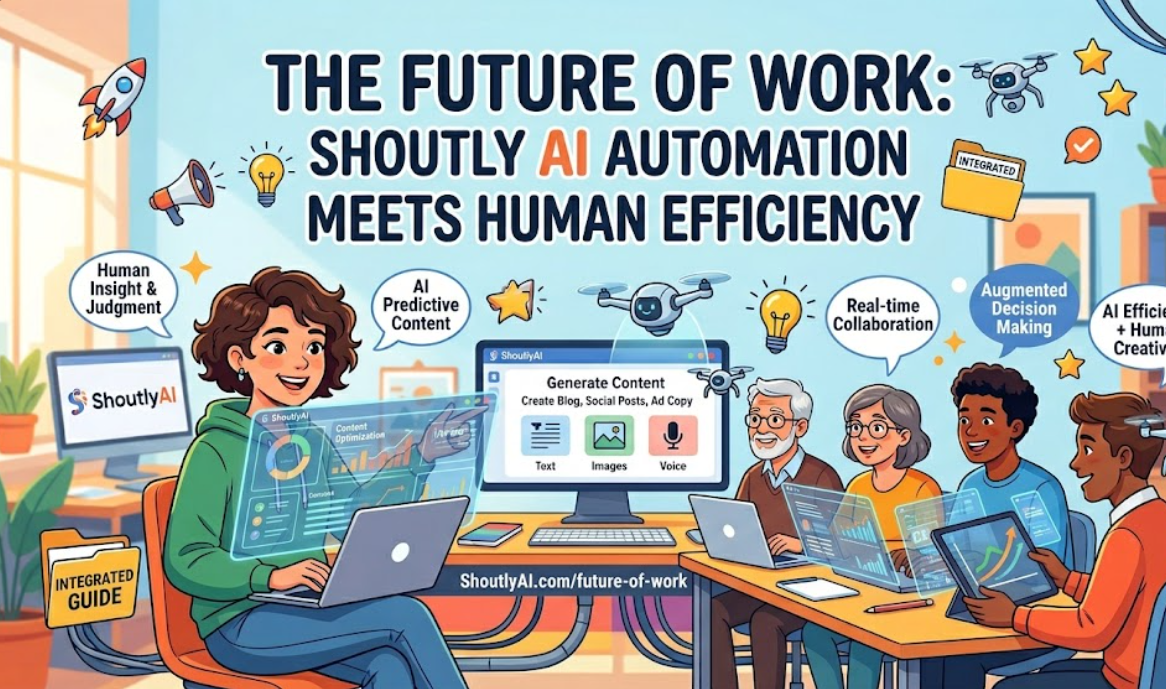
Moreover, Shoutly AI never removed human judgment. Therefore, it reframed it. Specifically, users guided tone, narrative, and brand voice while automation executed timing and distribution.
Consequently, this balance created a refined workflow model:
- Humans define intent and creative direction.
- Systems validate identity and data integrity.
- Automation executes distribution with precision.
- Feedback loops refine future actions based on performance signals.
- Human review ensures narrative consistency across campaigns.
Thus, the future of work appeared not as replacement but as refinement. Moreover, this model encouraged teams to think like system designers rather than task executors.
The Architecture of Data Trust and Verification
Furthermore, Shoutly AI’s architecture emphasized trust at every layer. Therefore, server-level verification ensured that every action tied back to a validated identity. Specifically, NPI registry-inspired systems maintained consistency across accounts and prevented duplication conflicts.
Consequently, this structure reduced ambiguity in campaign reporting. Thus, businesses could trace outcomes back to specific actions with clarity. Moreover, this traceability improved decision-making across marketing teams.
Behavioral Feedback Loops and Adaptive Systems
Moreover,Shoutly AI introduced feedback loops that refined automation over time. Therefore, each campaign contributed data back into the system. Specifically, engagement signals, timing responses, and audience interactions shaped future scheduling decisions.
Consequently, automation evolved continuously rather than remaining static. Thus, customers experienced improvement without manual recalibration. Furthermore, this created a sense of momentum within workflows.
The Human Narrative Within Data Systems
Moreover, despite its technical depth, Shoutly AI retained a human narrative. Therefore, every dataset represented real audience behavior. Specifically, engagement patterns reflected preferences, habits, and attention cycles.
Consequently, automation became a tool for understanding people, not just managing content. Thus, businesses shifted their perspective. They began to see social media as a dialogue rather than a broadcast channel.
The Intellectual Journey of Data-Driven Social Media
Furthermore, the story of Shoutly AI mirrors a broader shift in digital work. Therefore, companies now treat data as a narrative rather than a report.
Specifically, each dataset tells a story about audience behavior. Consequently, automation becomes the mechanism that acts on that story. Moreover, this approach bridges the gap between engineering and communication.
Thus, customers no longer ask if they should automate. They ask how precisely they can guide automation. Furthermore, this question reflects a deeper understanding of efficiency.
The Future Outlook – Systems That Learn from Behavior
Moreover, the next phase of Shoutly AI focuses on adaptive learning. Therefore, systems will refine posting strategies based on continuous feedback.
Consequently, automation will evolve alongside audience behavior. Thus, efficiency will not remain static. It will improve with every interaction. Furthermore, this progression signals a shift toward systems that think in patterns rather than rules.
Expanding the Boundaries of Work
Moreover, as automation matures, the definition of work continues to expand. Therefore, human effort moves toward strategy, creativity, and oversight. Specifically, repetitive execution becomes a function of intelligent systems.
Consequently, organizations restructure workflows around insight rather than activity. Thus, productivity becomes a measure of clarity and consistency rather than effort alone.
Call to Action
Therefore, businesses seeking consistency and clarity in social media should examine how automation integrates with human decision-making. Furthermore, Shoutly AI offers a structured path toward that balance. Thus, the journey begins with understanding your data and allowing systems to act on it with precision.
FAQs
- What does AI automation mean in social media?
It refers to systems that execute posting and analysis based on verified data. - How does Shoutly AI maintain data accuracy?
It uses server-level validation and structured identity mapping systems. - Can automation adapt to audience behavior?
Yes, feedback loops allow systems to refine actions based on engagement signals. - Why is continuous automation valuable?
It ensures consistent presence and reduces manual workload interruptions. - Does automation reduce creative control?
No, humans still define messaging, tone, and brand direction. - What role does verification play in campaigns?
It ensures that actions are tied to authentic and consistent account identities. - How do feedback systems improve performance?
They analyze engagement data and refine future posting strategies. - Is Shoutly AI automation suitable for small businesses?
Yes, it helps streamline operations and improve efficiency regardless of size. - What is the future of Shoutly AI in social media?
It will focus on adaptive learning and continuous improvement based on behavior. - How quickly can businesses see results?
Consistency improves first, followed by gradual engagement growth.